
Information Center

Illinois- Physical Ability Test Requirements

Candidates

Illinois - Physical Abilities Test Requirements

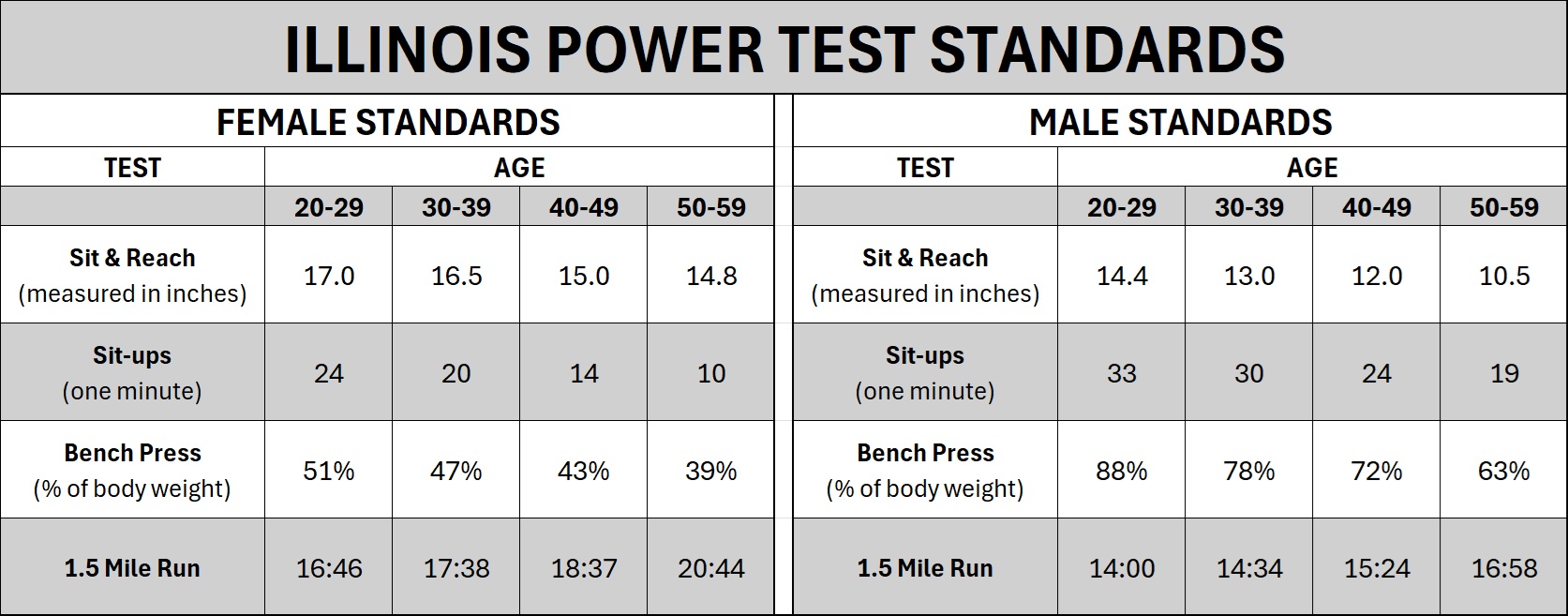
The Illinois Peace Officer Wellness Evaluation Report (POWER) is established by the Illinois Law Enforcement Training and Standards Board. It is designed to help to ensure that each recruit can undergo both the physical and academic demands of an academy without undue risk of injury and with a level of fatigue tolerance to meet all academy requirements.

The POWER test will be typically administered in the following order:

  1. Sit-and-Reach
  2. One Minutes Sit-ups
  3. One Maximum Repetition Bench Press
  4. 1.5-Mile Run

Physical Ability Test

Events

Event #1 - Sit-and-Reach

This test is a measure of the flexibility of the lower back and upper leg area. It is an important area for performing police tasks involving range of motion and is also important in minimizing lower back problems. The test involves stretching out to touch the toes, or further, with extended arms from the sitting position.

This test is performed with the shoes off. You may put your shoes off to the side, be seated on the floor, and place your feet against a solid object, such as a yoga block, stairs, or sit-and-reach device.

The proctor will place a yard stick or measuring tape at the top of the object so that the 15” mark is at the toes of the seated candidate.

When instructed, the place one hand over the other, and extend your arms forward toward your feet. With arms extended, bend forward in one fluid motion to reach as far as you can with your hands over the yard stick at toe level.

You are not allowed to bend at the knees, bump forward in jerky movements, or lean back to gain momentum to reach farther forward.

Your score is recorded in the inches reached on the yard stick or measuring device.

Event #2 - One Minute Sit-ups

This is a measure of the muscular endurance of the abdominal muscles. It is an important area for performing police tasks that may involve the use of force and is an important area for maintaining good posture and minimizing lower back problems.

Lie on your back with your knees bent at 90 degrees or tighter with your heels on the edge of the mat. Your feet may be together or apart, but the heels must stay in contact with the floor. Your partner will sit on your feet and wrap their arms around your calf muscle area or you may use a sit-up holder or place your feet under an object to hold them in place. It is your responsibility to inform your partner of any adjustments that need to be made before starting the test in order to assure your comfort. Your fingers must stay interlocked behind your head throughout the event. If your little fingers are not touching, that is considered "apart" and such performance will not be counted. Lift your body by bending at the waist. Touch your elbows to your knees and return to the starting position. When returning to the starting position, your fingers must touch the mat behind your head.

You may rest only in the up position and your fingers must remain interlocked the entire time. Do not arch your back or lift your buttocks from the mat. If you fail to: keep your fingers interlocked, touch your elbows to your knees or your fingers to the proctor's hand, or lift your buttocks off the mat, you will receive one warning. After one warning, incorrect repetitions will not count.

You will have one minute to do as many sit-ups as possible. Your score is the total number of correct sit-ups.

Event #3 - One Maximum Repetition Bench Press

This is a maximum weight pushed from the bench press position and measures the amount of force the upper body can generate.

Please lie flat on the bench with your eyes under the bar. Keep your head, shoulders, and hips in contact with the bench, and place both feet flat on the floor. Grip the bar evenly with both hands.

When you are ready, unrack the bar and hold it with your arms fully extended. Lower the bar in a controlled manner until it touches your chest. Then press the bar upward until your arms are fully extended again. Then rerack the bar.

Do not bounce the bar off your chest, lift your hips off the bench, or move your feet. The movement must be controlled throughout the lift. Uncontrolled movement will be considered a failure of this event.

Your score is a ratio of weight pushed divided by body weight for one repetition.

Event #4 - 1.5-Mile Run

This test is a measure of cardio-respiratory endurance (or aerobic capacity) used in extended control and defensive tactics training. This is important for performing tasks involving stamina and endurance (pursuits, searches, prolonged use of force situations, etc.) and for minimizing the risk of cardiovascular health problems.

You must complete the 1.5 mile course without any help. Your goal is to finish in as fast a time as possible. Try not to start too fast, but maintain a pace you can sustain for about 10 to 15 minutes. You may walk, but walking will make it difficult to meet the minimum passing time. You may run alongside another runner for help with pacing, but you may not physically assist or be assisted by anyone.


Where to take the POWER test

There are 3 main locations in the Chicagoland area that provide POWER testing services:

  1. Northeastern Illinois Public Safety Training Academy (NIPSTA)
  2. Triton Junior College
  3. Joilet Junior College

COMING SOON! Nationwide POWER testing at Anytime Fitness!


Preparing For the Physical Abilities Test

In preparation for the Peace Officer Wellness Evaluation Report (POWER); individuals should take into consideration many factors that will influence their training. Among these are: current training routines; knowledge of training modalities; specific goals for training; and an understanding of the components of fitness. Individuals that currently exercise regularly and across all components of fitness should be prepared for the test with possibly some minor adjustments to their routine. Before beginning any exercise program, it is important to consult a physician about your current state of health and any problems that arise during your selected form of exercise.

Components of Fitness

Flexibility - The ability to elongate muscles and move joints through a normal range of motion.

Cardiovascular Endurance - The ability to elevate the heart rate and maintain that elevated heart rate for extended periods of time.

Muscular Endurance - The ability of a muscle or muscle group to perform repeated movements for extended periods of time (sub-maximal).

Muscular Strength - The greatest amount of force a muscle or muscle group can exert in a single effort (maximal).

Warm-up and Dynamic Flexibility

A good warm-up is key in developing flexibility and preventing injury. In order for muscles to elongate they must be warm. To make this happen "Just Move." No matter your preferred movement; jogging, back-pedaling, side shuffles, skipping, jumping rope, shadow boxing; "Just Move" for 3-5minutes to warm-up before beginning dynamic stretching.

Dynamic stretching is the elongation of muscles through movement. While slowing from the warm-up you should continue to move during dynamic stretching. The following some examples of dynamic stretches that could be utilized during a warm-up.

1. Walking Lunge - Step forward with a long stride, keeping the front knee over the ankle. Drop back knee toward the ground without touching the ground. Stand up and walk a couple of steps and repeat on the other leg.

2. Knee Hug to a Lunge - Bring one knee to the chest; release into a lunge; walk a couple of steps and repeat on the other leg.

3. Alternating Side Lunge - Long stride to the side. Squat down keeping the back leg straight and entire sole of the foot planted on the ground. Stand up and walk a couple of steps, face opposite direction and repeat on the other leg.

4. Lunge with a Twist - Same as a walking lunge with the addition of an upper body rotation over the forward leg at the bottom of the lunge.

5. Walking Toe Grab - Reach down and grab toes on same side, keeping leg straight. Stand up and walk a couple of steps and repeat on the other leg.

6. Straight-Legged March - Keeping legs straight, kick one up in front of body as high as possible. Reach out with opposite side hand and try to touch the toes. Walk a couple of steps and repeat on other leg.

7. Bent Knee Glute Sit - Keeping one leg straight, bend other at the knee across straight leg just above the knee. Put slight downward pressure on the knee while at the same time putting slight upward pressure at the heel. From this position sit down until you feel a stretch through the glutes. Stand up and walk a couple of steps and repeat on the other leg.

8. Ankle Pick to a Toe Touch - Keeping one leg straight, bend other at the knee and behind the straight leg. Grab foot with opposite side hand. Bend over and touch toes with available hand. Walk a couple of steps and repeat on the other leg.

Physical Ability Preparation and Conditioning
1. Preparing for the Sit and Reach Test

Performing sitting type of stretching exercises daily will increase this area. There are two recommended exercises.

  • Sit and Reach. Do 5 repetitions of this exercise. Sit on the ground with legs straight. Slowly extend forward at the waist and extend the fingertips toward the toes (keeping legs straight). Hold for 10 seconds.
  • Towel Stretch. Sit on the ground with the legs straight. Wrap a towel around the feet holding each end with each hand. Lean forward and pull gently on the towel extending the torso toward the toes.

2. Preparing for the Sit-up Test

The progressive routine is to do as many bent leg sit-ups (hands behind the head) as possible in 1 minute. At least three times a week, do three sets (three groups of the number of repetitions one did in 1 minute).

3. Preparing for the 1 Repetition Maximum Bench Press

If one has access to weights, determine the maximum weight one can bench press one time. Take 50% of that poundage. This will be the training weight. One should be able to do 8-10 repetitions of that weight. Do three sets of 8-10 repetitions adding 2 1⁄2 to 5 pounds every week.

  • If one does not have weight equipment, then the push-up exercise can be utilized. Determine how many push-ups one can do in 1 minute. At least three times a week, do three sets of the amount one can do in 1 minute.

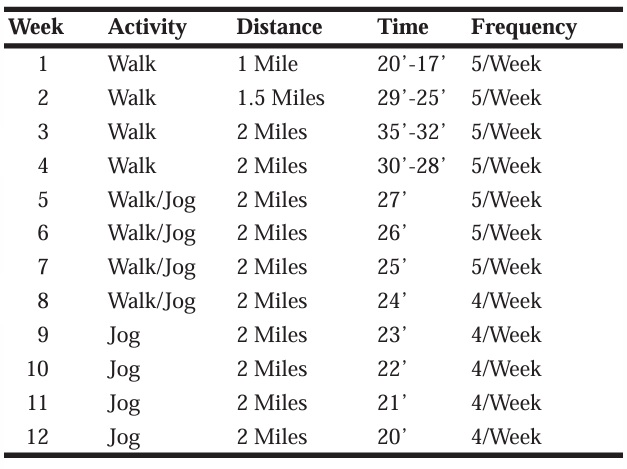
4. Preparing for the 1.5 Mile Run

Below is a gradual schedule that would enable one to perform a maximum effort for the 1.5 mile run. If one can advance the schedule on a weekly basis, then proceed to the next level. If one can do the distance in less time, then that should be encouraged.